How to Memorize Your Monologue: Methods to Practice
The path from page to stage isn’t always easy when it comes to learning your lines; it is a process that every actor must undertake.
How do I memorize my monologue?
The steps provided can be done in no particular order. Go about the suggestions based on what you believe might help you get off-book.
1. Repetition Variation
The more you go over your monologue, the better off you will be learning your lines.
Even though repetition is a good way to memorize your monologue, there’s a possibility it could lead to a mechanical delivery in performance.
To avoid this, when repeating your lines, a good approach is to say the words differently each time.
Deliberately change how you say the lines.
- Adjust the pacing–quickly/slowly
- Alter the pitch–high/low
- Adjust your voice–robotic/with an accent
2. Physical Action
Try learning your lines while you are in the act of doing something physical.
Maybe you can do your laundry, and while folding your clothes, go over your lines.
Perhaps you can do the dishes in your sink, organize a room, or walk in a park.
When you apply physical action to the words, you are allowing yourself to know your lines subconsciously.
Physical movement while studying lines will also help you avoid rigid staging.
3: Connecting Words
Say the monologue out loud to yourself, one sentence at a time, bringing yourself closer to the text emotionally.
Carefully read through your monologue, and ask yourself questions:
- What does my character want in this monologue?
- Who are they talking to?
- What is the character’s underlying emotion?
Breaking down the subtext of your monologue will help you connect to the words you speak naturally.
As you discover a deeper understanding of the emotional landscape of your monologue, it will become less about remembering the words and more about knowing why you are saying them.
4: Break Your Monologue Down
It’s always best to break down your monologue into smaller bits to help make learning the text easier.
Try marking your monologue script with beats. A beat is a natural shift in your character’s emotion and thought.
Concentrate on each beat separately, instead of the entirety of the monologue.
Break your monologue down into beats. It will look something like the following: A Leave of Absence Monologue
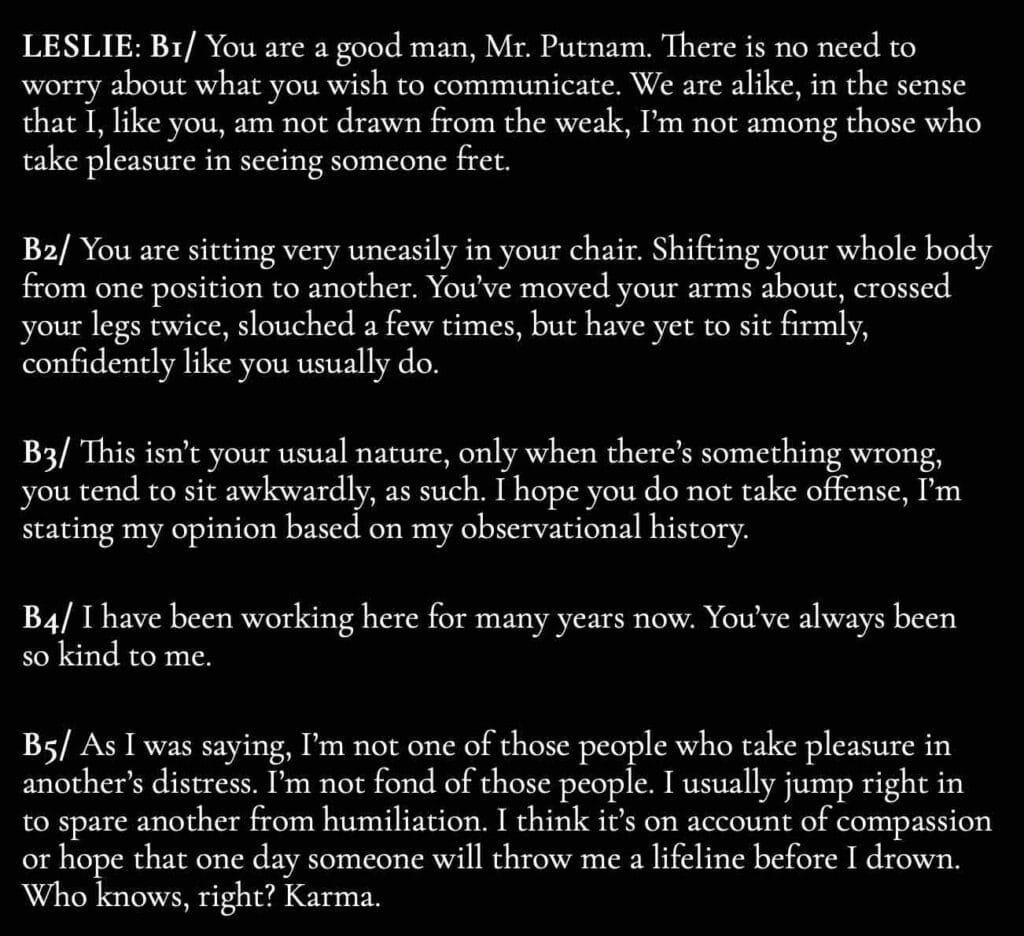
As you begin to piece each beat together, you’ll notice that your monologue will start to flow more seamlessly.
This method will help prevent you from having your monologue overwhelm you and instead give you an easier path to knowing your script.
5. Write Your Monologue Out by Hand
Writing your monologue out by hand is an effective approach to learning your lines.
Your mind will be engaged with the words differently. You will allow yourself to process the words at a slower rate, internalizing the text.
6. Practice with a Recording Device
Using a recording device can prove useful for learning your monologue.
Some actors learn better by hearing the lines, and a recording device may help you internalize the text.
One word of caution is that by using a device like a recorder, be mindful that you don’t get stuck on also memorizing your delivery.
7. Rehearse with a Partner
Rehearsing your monologue with a fellow actor can be helpful as they can keep an eye on the script for you, following along to make sure you are saying them correctly.
You may even wish to have your creative partner say your monologue out loud instead so you can hear it differently.
Listening to someone else say your monologue is another method you are welcome to try.
Final Thoughts
There is an abundance of memorization techniques out there.
It is never an easy process; learning lines can be daunting for most actors. Have patience and be positive about your ongoing progress.